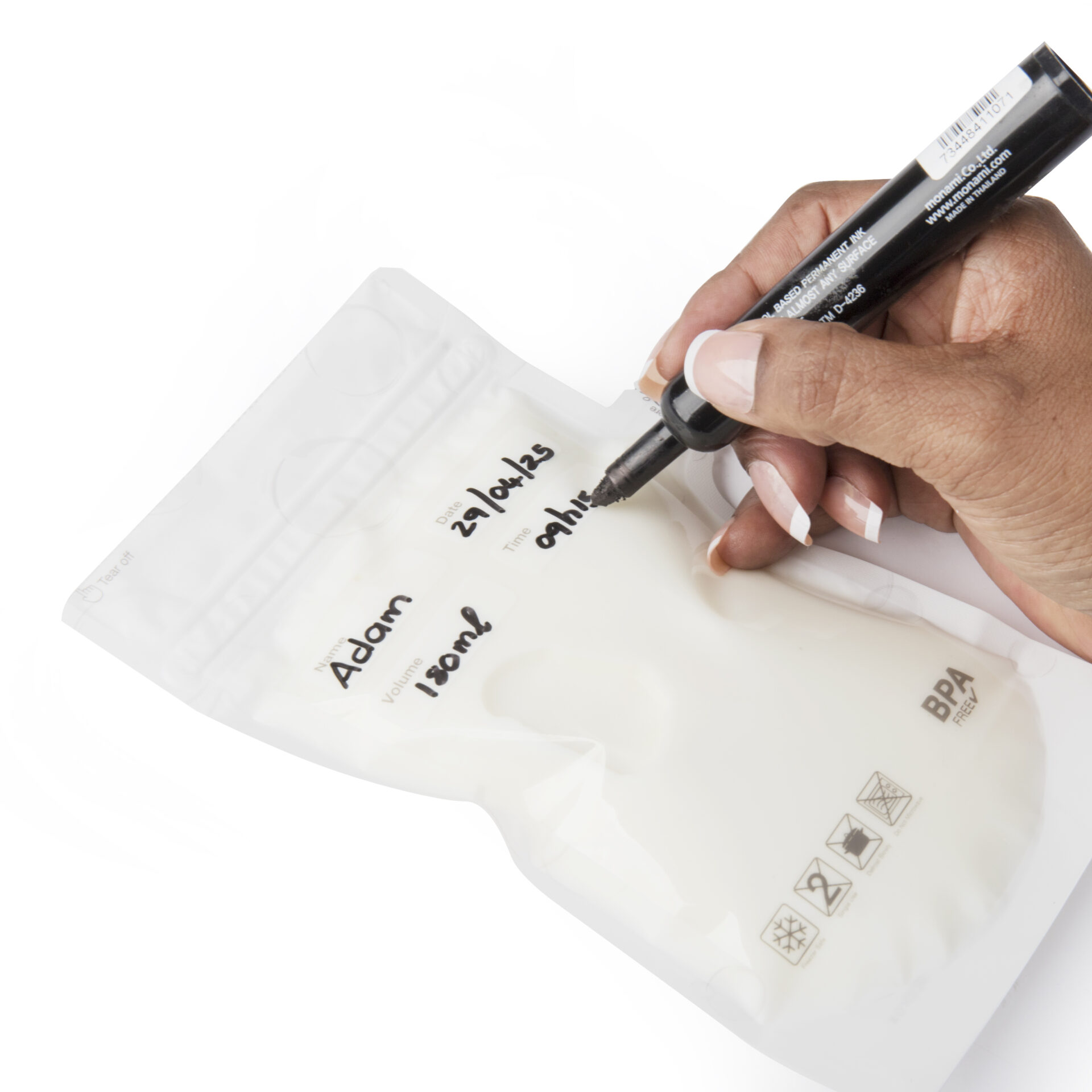
Why do my breast milk storage bag measurements look different from my bottle readings?
This is one of the most common questions moms ask! Breast milk storage bags are flexible, not rigid, so their shape changes depending on:
• How you hold them
• How much air is trapped
• Whether the base is fully expanded or folded
Because the calibration lines were printed when the bag was in a specific shape, any change to that shape alters how much volume the same amount of milk appears to occupy.
For example, 100 ml might look like 90 ml if the base isn’t fully expanded, or 110 ml if the bag is stretched.
In short, your milk amount hasn’t changed — only the bag’s shape affects how it reads. This is normal across all brands of breast milk storage bags in South Africa.
Are baby bottles more accurate than breast milk storage bags for measuring milk?
Yes. Baby bottles are rigid containers, so their internal volume stays constant and gives more accurate milk measurements.
However, even bottles from different brands can vary slightly — usually only by a few millilitres — due to small manufacturing differences.
For the most consistent readings, use the same bottle every time before transferring milk to your Snookums storage bag.
Why does frozen or thawed breast milk show a different measurement?
When breast milk freezes, it naturally expands. When it thaws, it contracts again.
The actual amount of milk remains the same — it’s just the temperature affecting volume.
That’s why your milk might appear to “shrink” or “grow” in the bag when frozen or thawed — the liquid hasn’t changed, only its density and space.
What’s the difference between breast milk weight and volume?
Many South African moms notice that the grams on a kitchen scale don’t match the millilitres on the storage bag. Here’s why:
Weight vs Volume
• Air bubbles or leftover air in the bag change how milk settles.
• Frozen milk slightly expands, so measurements can look higher.
• Breast milk density is about 1.03 g/ml, meaning 100 ml ≈ 103 g.
These tiny differences cause small inconsistencies between grams (weight) and millilitres (volume), and they’re completely normal.
How do hospitals, NICUs and milk banks measure breast milk accurately?
Professional settings like NICUs (Neonatal Intensive Care Units) and human milk banks follow strict accuracy protocols.
Here’s their step-by-step method:
- Express or pour milk into a rigid bottle or measuring cup.
- Measure the milk using the bottle’s printed lines.
- Transfer it to a Snookums Breast Milk Storage Bag and label it clearly.
Both the South African Department of Health and the World Health Organization (WHO) https://www.who.int/tools/essential-newborn-care-course/materials recommend using a hard-sided container for measuring before transferring to flexible bags. This ensures consistent, traceable records — exactly what you can replicate at home for peace of mind.
My Snookums milk storage bag shows less milk than I pumped — did I lose some?
No, you didn’t lose any milk!
The flexible plastic simply shifts shape as air is released or the bag lies flat, which can make it look like there’s less milk.
Always rely on the amount you recorded when you poured it in, not what the bag appears to show later.
This is a common concern among breastfeeding moms in South Africa, but it’s entirely normal.
Are measurement differences a sign of poor-quality breast milk storage bags?
Not at all.
Small measurement variations are normal across all flexible breast milk storage bags — even the top international brands.
Snookums Breast Milk Storage Bags are independently tested for leak resistance, hygiene, and safety compliance.
Differences occur purely because flexible plastic behaves differently from rigid bottles. Your milk is safe and accurately stored.
Why is my breast milk storage bag leaking after freezing?
When freezing liquids in a flexible plastic bag, the material becomes more brittle at very low temperatures. If the bags bump or rub against one another while frozen, small hairline cracks can form — which may lead to leaks once the milk thaws.
To prevent this, we recommend placing the filled bags upright next to one another inside a protective container (such as an old ice-cream tub, butter container, or Tupperware). This prevents friction and freezer damage.
It’s also important not to overfill the bag. Milk, like any other liquid, expands when frozen, and overfilling can cause pressure on the seams, resulting in leaks.
For best results, store no more than 250 ml per bag. If you’re expressing more milk, simply use multiple bags — this way, you’ll minimise waste and protect your stored milk from freezer damage.


